Notebooks and journal
Notebooks and handwriting
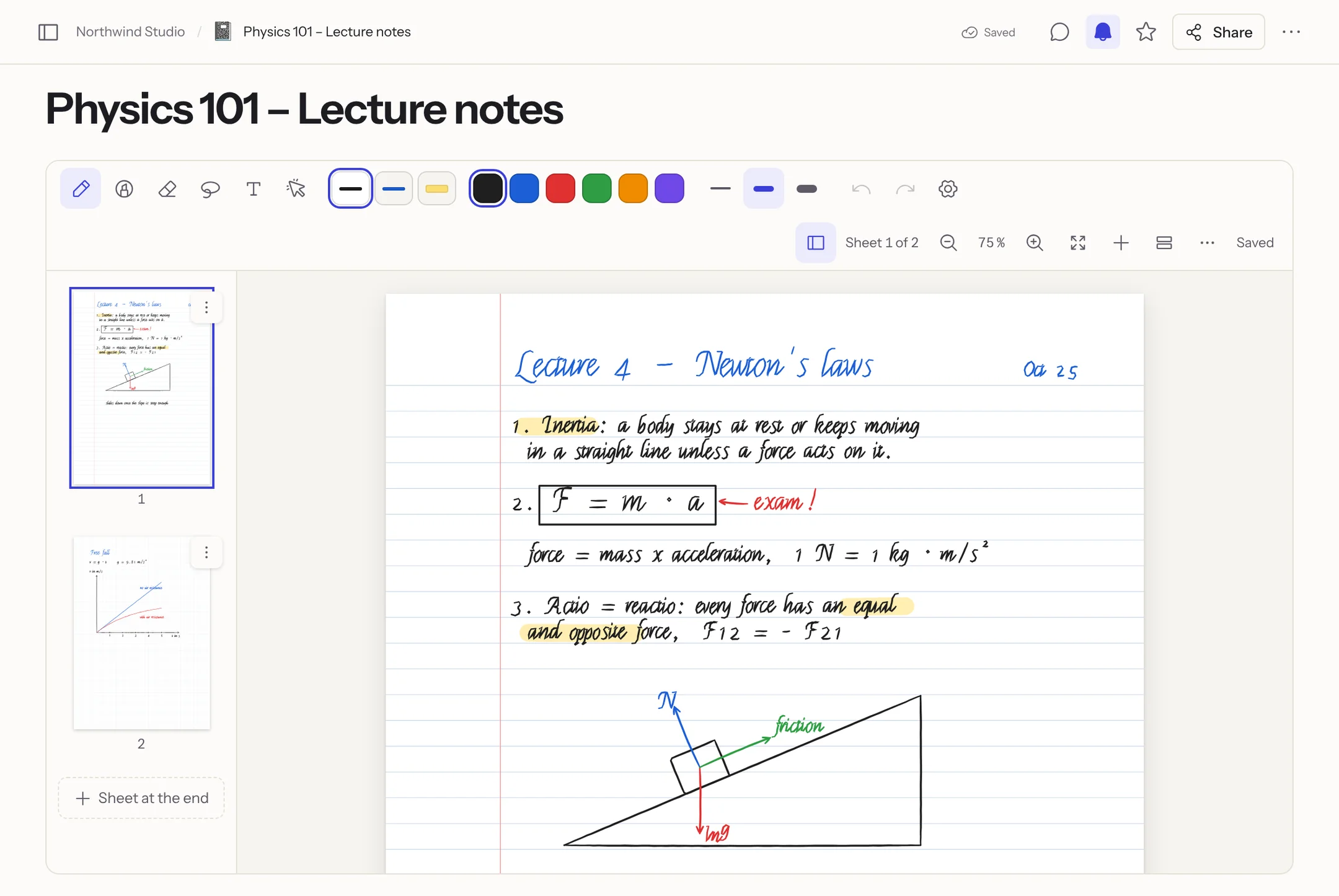
A notebook is a page of sheets to write on – with the Apple Pencil, another tablet pen, a mouse or a finger, like a paper notebook. The sheets sit one below the other and you scroll through them. Each sheet has its paper (lined, grid, dotted, Cornell, music staff …) or a page of a PDF as its background. There is also handwriting in documents: a drawing block in the middle of the text.
10 min read
On this page
Creating a notebook
New page → Notebook (or New notebook in the command palette). A new notebook starts with one sheet of lined A4 paper.
From a PDF: in the same dialog, choose a file under Open a PDF as the notebook. Every page of the PDF becomes a sheet with that page as its background – lecture slides, worksheets or forms are then written on as if printed. ⋯ → Import PDF … adds more PDF pages to an existing notebook, after the current sheet. Up to 500 pages per import and 1000 sheets per notebook.
From GoodNotes and other note apps: export the notebooks as PDF and import them under Settings → Import & export → Import with the source GoodNotes – several at once or as a ZIP, every PDF becomes a notebook. Step by step: Moving from GoodNotes.
Paper
| Template | Looks like |
|---|---|
| Blank | no lines |
| Lined (college) | lines 7.1 mm apart (college ruled) with a margin |
| Lined (wide) | lines 8.7 mm apart (wide ruled) with a margin |
| Grid (5 mm) | squared paper |
| Dotted | dots every 5 mm |
| Cornell notes | title band, cue column on the left, summary at the bottom |
| Music staff | 12 staves (8 in landscape) |
Plus A4 or Letter, portrait or landscape, and light or dark. On dark paper, black ink shows light and the highlighter glows.
The lines icon in the toolbar (or Change paper … in a sheet's menu) opens the choice. Apply to:
- This sheet – only the current sheet gets its own paper;
- Notebook default – for all sheets without their own paper and for new sheets;
- All sheets – sets the default and removes every sheet's own paper.
Sheets from a PDF keep their PDF page and its size.
Writing
Whoever may edit the page writes right away – there is no "Annotate" step as in the PDF viewer. At the top is the toolbar: Pen (with pressure), Highlighter, Eraser (whole strokes or partial), Lasso (move, resize, recolour, copy, duplicate, delete), Text and Laser pointer, three favourite pens, colours, widths and the pen settings. They work as when annotating PDFs: only the pen writes once you have used it, fingers scroll and zoom, a resting hand leaves no marks; holding still at the end of a stroke straightens it into a line, rectangle, ellipse …
Everything is saved as you write (on the right of the toolbar: Saved). Every change of a sheet is a version. When two people write on the same sheet at the same time, both keep their strokes; a notice says that someone wrote along. What others write appears after a few seconds.
Readers of the page see all sheets, zoom and export, but no tools.
Besides the preset widths, the slider button sets any line width, with a preview. The + after the colours opens a custom colour (colour field, hue, hex value); your recent custom colours are remembered on the device. For Text you choose the size (8–96 pt) and the font there: Default, Instrument Sans, Instrument Serif, JetBrains Mono, Caveat or Patrick Hand. In the PDF export Caveat and Patrick Hand come out as Helvetica, Instrument Serif as Times and JetBrains Mono as Courier.
With 'Insert PDF …' (in the plus menu or under 'More actions') you add a PDF to an existing notebook – before the first sheet, after any sheet or at the end; in the page overview, a sheet's menu offers 'Insert PDF before/after …' directly. Each PDF page becomes a sheet of its own with the page as background that you write on as usual (at most 500 pages per PDF, 1000 sheets per notebook). Two fingers zoom smoothly at the spot between them and move the sheets; on a trackpad, pinch or use Ctrl + scroll, and the Apple Pencil keeps writing undisturbed.
PDF as an attachment New in 0.10.2, in the :beta image: in the Insert PDF dialog you choose As sheets (as before) or As an attachment. An attachment stays a whole PDF and does not become a sheet: it sits in the Attachments strip above the sheets and opens with a tap in the side panel beside your sheets – to read, annotate and take regions from, which land on the sheet as a picture with a link to the PDF page. The × on an attachment takes it off the strip; the file stays on the page.
Every tool in detail – keyboard shortcuts, favourite pens, shapes and ruler, lasso, handwriting to text, pictures and stickers, audio – is under Notebook tools.
Page overview
Overview, contents and presenting. "All sheets and contents" opens every sheet as a grid. Tap a sheet's bookmark and filter with "Bookmarks only". Search finds titles, typed text and recognised handwriting and marks the matches. To reorder, drag a sheet with the mouse, hold and drag it with a finger or the Pencil, or move it with Alt + arrow keys. Under "Select" (Shift for a range) you duplicate, move or copy several sheets to another notebook, change their paper, export them as PDF or delete them. Deleting can be undone at once and restored for 30 days from "Deleted sheets …". The "Contents" tab lists your chapters (a sheet's menu → "Mark page as a chapter", indent, outdent, rename) and your bookmarks; a tap jumps there. "Insert link …" links to another sheet or page. "Present" shows the notebook full screen, sheet by sheet (arrow keys, Page Up/Down, swipe), with a laser pointer and a marker that fades after a few seconds. Anyone who has the notebook open, even read-only, sees "Follow" and then your sheet and pointer live. Select typed text with the lasso and 'Add to the contents as a heading' adds an entry to the contents that jumps to that spot. With several sheets selected in the overview, 'Paper …' changes the paper of all of them at once.
The sidebar icon on the left of the toolbar shows all sheets as previews; a tap jumps to the sheet. With ⋯ on a preview: New sheet after, Duplicate (with everything on it), Change paper …, Move up, Move down and Delete. You also change the order by dragging a preview or with ⌥↑/↓ on the focused preview. + in the toolbar adds a sheet after the current sheet or at the end, as does Add sheet below the last sheet.
Exporting as PDF
⋯ → Export as PDF downloads the notebook as a PDF: one page per sheet in the sheet's size, paper and handwriting as vectors (sharp at any zoom), PDF sheets with their original page including its text. The Markdown export puts the notebook into the ZIP as a PDF as well and writes a short Markdown file with a link to it and the recognised text. The PDF, Word and EPUB exports show the sheets as pictures (Word: only their text). Published and shared notebooks are read-only.
Handwriting in documents
Type /draw in a document (also /zeichnen, /dessin, /handwriting or /sketch): a drawing block across the full width appears and you draw in it right away – the toolbar with the block's paper (Blank, Lined, Grid) and Done is already there. Since 0.9.8 With the first new drawing block on a device, a short tip at the top of the block shows for a few seconds where you change the height after Done; tap it to hide it at once. Since 0.10.0 Drag the bottom edge to change the height (or use the arrow keys on the handle); while you draw, the handle is hidden so a resting hand can't move it. Since 0.10.0
Resting your hand Since 0.9.8: when you open the block with a pen or a finger, the rest of the app is protected from touches until Done – a resting hand or a stray pen stroke next to the block doesn't scroll, tap anything or move the cursor. To finish, use Done on the block or Esc; when the block's toolbar is scrolled out of view, a separate Done button appears at the top (or bottom) of the screen. If the block scrolls out of sight entirely – say after a swipe with momentum – touches scroll the page again so you can swipe back to it; drawing goes on until Done. New in 0.10.2, in the :beta image While you draw there's no cursor in the text, so what you write with the Apple Pencil stays handwriting and isn't turned into text by Scribble. A hovering Pencil shows a dot where it would draw and highlights the button under it. Opened with the mouse, there is no protection; a click next to the block ends drawing as before.
Drawing again Since 0.10.0: you open an existing drawing block only with Draw at its top right – with a pen, a finger and the mouse alike, so editing is always intentional. On the surface of a closed block the Pencil behaves like a finger: it scrolls the document and taps, but doesn't draw. A new drawing block still starts in drawing mode right away.
Block menu Since 0.10.0: next to Draw, … opens the block's actions: Move up and Move down move it by one block, Duplicate puts an independent copy with the same drawing below it, Reset height restores the default height, and Delete removes it (Undo brings it back). This way you reach these actions on an iPad too, where the handle to the left of the block is hard to hit with the pen in your hand. On locked or read-only pages there is neither Draw nor ….
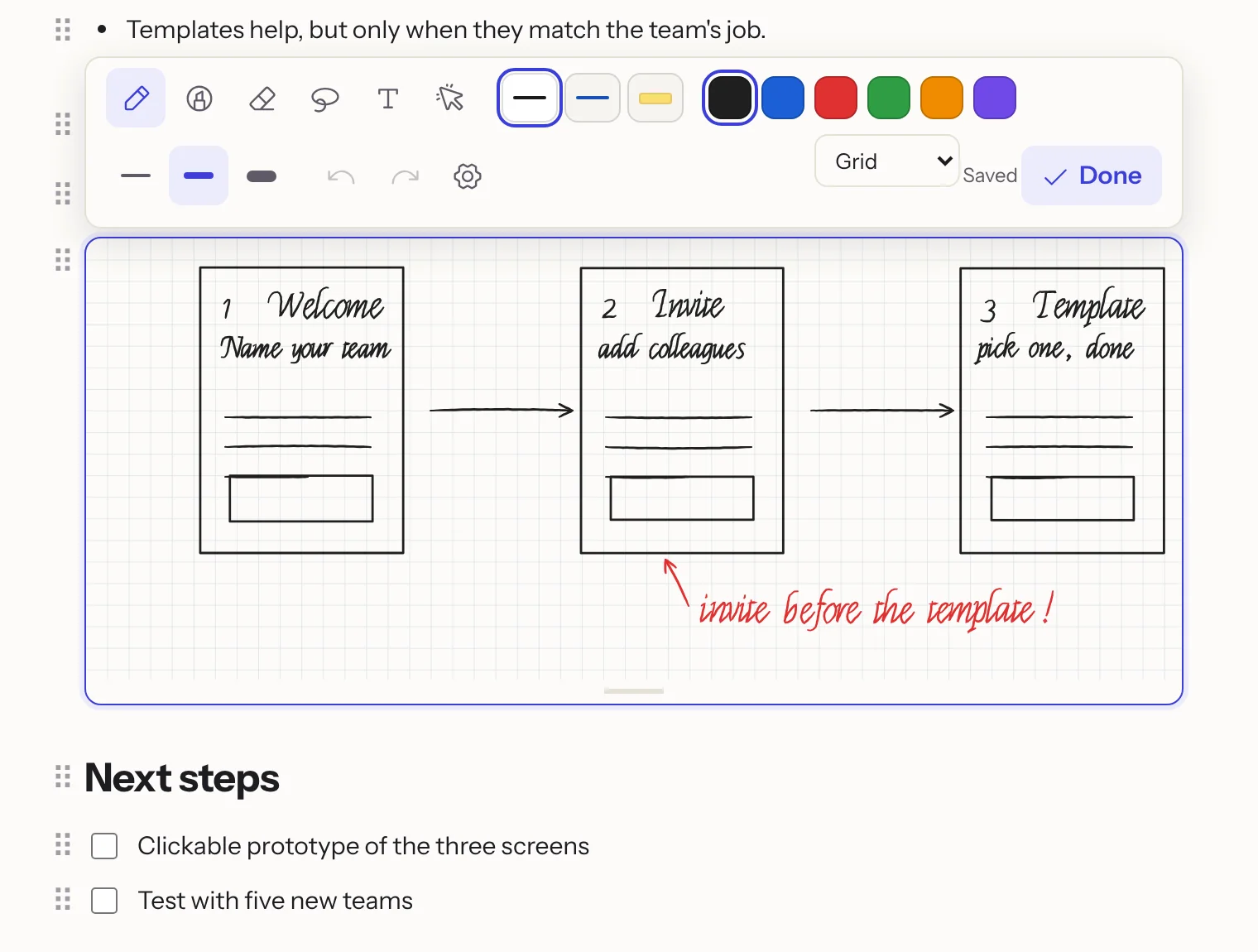
The handwriting belongs to the block and is saved as you draw. For working together this means: when several people draw in the same block at once, their strokes are merged instead of overwritten; the text around it you edit together as always. Copied or duplicated blocks (also into another document) take their drawing along and are independent afterwards. Permissions, locking and the trash work as for the document; on published pages, in share links and in exports the block shows as a picture.
Recognising handwriting (iPhone and iPad)
In the Flowplan app for iPhone and iPad the device itself recognises what you write – the strokes do not leave the device for this:
- Search: shortly after saving, the handwriting of a sheet, a drawing block or a PDF page is recognised and its text saved along. Search then also finds notebooks, documents and PDFs by what is handwritten.
- Convert to text: select handwriting with the lasso and choose Convert to text (the Aa icon) in the selection's bar. In a notebook and on PDFs, typed text replaces the strokes in their place; in a drawing block the text becomes a paragraph below the block. Undo brings the strokes back.
In the browser and the desktop app there is no recognition; Convert to text does not appear there. Text typed on sheets, in drawing blocks and on PDFs is searchable everywhere.
Limits
- Encrypted spaces have no notebooks and no drawing blocks.
- Locked pages show the handwriting; it can be changed after unlocking.
- A notebook's page versions only hold its appearance; each sheet has its own versions of the handwriting.
- Drawing blocks exist in documents and journal days, not in the documents of database records.